


Over the past 10 years, hive monitoring has expanded rapidly, and the range of available hive scales has grown accordingly. Today, beekeepers are faced with a large and sometimes confusing diversity of solutions: more than fifty commercial vendors worldwide, along with around thirty open-source projects.
Faced with this abundance, choosing the right hive scale is not straightforward. The purpose of this article is to help readers make sense of the available options by highlighting the key technical and practical differences between systems, and by providing a clear framework for informed decision-making.
Although each solution has its own specificities, most hive scales can be analysed using a common set of criteria. In the sections that follow, we will examine them through five complementary perspectives:
- Hive scale architecture
- System and transmission architecture
- Software features and daily use
- Support and durability over time
- Cost
So we’ll break down each of these points. But before we go any further, it is important to note that there is no single “winning” solution—only solutions that fit specific needs. Beekeeping contexts vary widely: migratory or stationary operations, pollination services, honey production, palletized apiaries, and scientific monitoring all impose different constraints and objectives.
So let's move ahead visiting all of the topics listed above. We start with scale architecture.
Hive scale architecture
The scale architecture will be an essential factor in your choice. Despite the diversity of the offer, the technical choices for weighing a hive are not infinite. In practice, and except for some marginal exceptions, they are reduced to 3 architectures which are characterized by the number of sensors (or load cells) installed.
Single load cell scales
This architecture is well illustrated by the former Capaz scales. In this article, we generally avoid referring to specific manufacturers. However, Capaz deserves a brief mention for historical reasons. Its founder, Guido Koch from Oberkirch in Germany, was among the first to develop modern hive scales in the mid-2000s, at a time when such tools were still largely unknown to beekeepers.
As Capaz GmbH is no longer active today, it can be mentioned here simply as a reference point—an early and influential step in the evolution of hive-weighing systems.
So let us return to single load-cell scales. In this architecture, the load cell is usually located at the center of a rigid, often double H-shaped metal structure. This type of design is commonly found in applications requiring controlled and repeatable weight measurements, such as retail or industrial weighing systems. It is therefore not unusual to encounter similar principles in everyday settings like butcher’s shops or other commercial weighing environments.
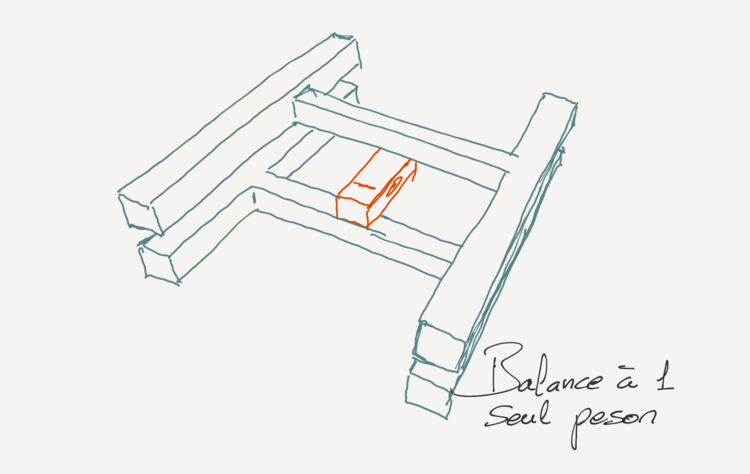
While mechanical rigidity is often presented as a key strength of this architecture, it comes with a significant drawback: the weight of the scale itself. Single load-cell hive scales typically weigh between 8 to 12 kg—a non-issue in a butcher’s shop, but a real operational constraint for migratory beekeeping.
The substantial mass of these scales is primarily intended to ensure a very rigid structure around the load cell, so that all mechanical deformation is concentrated on the load cell itself. In practice, however, increased weight and rigidity do not automatically translate into higher usable accuracy in field conditions, where installation constraints, environmental factors, and long-term stability also play a major role.
This architecture has a second limitation related to hive stability on the scale. Because all forces are transmitted through a single load path—the load cell connecting the upper platform to the base—the system is, by definition, supported at a single point.
In controlled weighing contexts, such as retail environments, this is not an issue: the load is compact, stable, and applied for a short time. In beekeeping, however, placing a full hive with several supers (high center of gravity) on a single-point support can introduce slight oscillations, particularly during handling or when the ground is uneven.
Beyond measurement considerations, hive stability also matters for the colony itself. Bees are sensitive to movement, and repeated rocking—whether caused by wind or during inspections—is a source of disturbance. Increasing the stiffness of the structure can reduce these movements, but this generally comes at the cost of additional weight, bringing us back to the trade-off discussed earlier.
In this category, when high-quality load cells are used (require C3 minimum according to OIML classification), single load-cell scales can achieve accuracies on the order of ±50 g under controlled conditions. However, this level of performance depends not only on the load cell itself, but also on the mechanical design, calibration procedure, and operating conditions.
As a result, this architecture is often considered suitable for scientific or research-oriented applications where controlled installation and careful calibration are possible, and where measurement repeatability is prioritized over operational flexibility.
Migratory beekeeping
Single load-cell scales have long been used in migratory beekeeping, especially in the early days of hive monitoring, as they are largely insensitive to leveling and installation constraints.
In practice, however, their weight and bulk quickly become operational limitations. Metal frames weighing 8–12 kg are cumbersome to handle repeatedly, and during migration they are difficult to transport: they rarely fit on a passenger seat, while the cargo area is typically already occupied by hives and equipment.
Field experience further shows that such constraints often limit deployment to a single monitored hive. In this context, higher measurement accuracy on one colony may come at the expense of observing additional colonies. In general, deploying two lighter scales on two different hives provides broader and more representative insight into overall apiary dynamics.
Two load-cell scales
Scales with two load cells often look like a bar. This bar, which is placed at the front or back of the hive, has a cell at each end.
This type of scale measures only half of the hive weight. The total hive weight is therefore estimated as weight_hive = weight_scale × 2, assuming that the hive’s center of gravity is reasonably centered along the front–rear axis.

The advantage of this architecture is its lightness and compactness. Around 1 kg for this scale, which makes it very easy to handle and install. The cost will also benefit from this material saving as well as the transport to ship it to you. The disadvantage is that the hive must be properly seated and leveled. You will need a similar sized wooden bar on the opposite side of the hive to make sure that the hive is well supported on all sides.
Typically, this category of scales is adapted to sedentary beekeeping. When the hive benches are well in place and we can ensure that they are leveled, they will give excellent results with an accuracy of around +/- 100 to 150gr depending on the model. It is certainly one of the flagship products for hobby beekeepers.
Four load-cell scales
In this category, we return to scales that measure the full weight of the hive. The four load-cell architecture combines the main advantages of the two previous designs. The entire hive weight is measured without requiring precise centering or leveling, and the hive is supported on multiple points, providing excellent stability with no rocking or tilting.

This scale architecture is particularly well suited to migratory beekeeping. It can be deployed in demanding working conditions, including night work, without requiring time-consuming installation or precise adjustments. Even on sloping ground or imperfect bases, the measurements remain reliable and stable.
Its compact size and low weight also make logistics much easier: several scales can be transported together and easily stored under a passenger seat, leaving the cargo area free for hives and equipment.
Finally, this architecture is well adapted to pallet integration, making it compatible with large-scale and professional beekeeping operations.
In terms of accuracy, our field and workshop experience shows that four load-cell scales can perform just as well as single load-cell systems when high-quality load cells and a robust calibration process are used. This conclusion has been confirmed over time through multiple retrofit operations and repeated calibration campaigns carried out on a wide range of single load-cell scales from four different manufacturers. All tests were conducted in our workshop using the same quality control and calibration procedures applied to our own four load-cell systems. Under identical test conditions and across successive calibrations, both architectures consistently demonstrated comparable performance in real-world use, with typical accuracy for the best ones on the order of ±50 g over a temperature range of ±10°C.
As with any weighing system, performance depends less on the number of load cells than on the overall system design, including the grade of the load cells employed (C3, C2, or unclassified), the mechanical integration, and the calibration methodology.
The following table summarizes what we have just seen:
|
Architecture |
Advantages |
Drawback |
Usage |
|
Single load cell scales |
Full hive-weight measure Accuracy ~ ±50g Insensitive to leveling and seating error
|
Footprint Weight ~ 8-12kg
|
Industrial |
|
Double load cell scales |
Lightweight < 1kg Small footprint Easy to install Cost |
Half hive-weight Accuracy ~ ±100-200gr sensitive to leveling and seating
|
Sedentary beekeeping |
|
Four load cell scales |
Full hive-weight measure Lightweight < 3kg Small footprint Easy to install Unaffected by leveling and seating defects Accuracy ~+/-50g Palletizable. |
Depending on the model: size or cables |
Migratory beekeeping
Sedentary beekeeping
|
Now that we have seen the hive scale hardware architecture, let's move to their system communication architecture
System architecture
Connected devices rely on network access to transmit their data. Depending on whether they operate independently or as part of a local network, two main system architectures can be distinguished:
- Autonomous communicating sensors: They embed the communication system to the cloud. In this case the product is completely autonomous, with its own subscription.
- Sensors operating in a local network: typically the sensor communicates in a local network to a Hub or Gateway placed in the apiary which mutualises the means to communicate to the cloud. This networked solution allows to operate a larger number of sensors (scales, brood probes, weather stations, bee counters, cameras etc.) with only one subscription which is the one of the Hub. Or even without subscription if the local communication protocol is Bluetooth and you decide to perform manual synchronizations with your smartphone.
|
System architecture |
Advantage |
Drawback |
|
Autonomous sensors |
Autonomous device stand alone |
Hardly expandable (cables) One subscription per device |
|
Sensors in local network to a gateway |
Monitor several hives and/or apiary properties with a single subscription Shared transmission function. Manual synchronization possible |
Device associated with a Hub for transmission to the cloud |
Transmission network
We can distinguish the communication networks used by hive sensors into three main categories:
- Conventional cellular networks (2G, 3G, 4G), using public mobile infrastructures.
- Low-power cellular networks (LTE-M, NB-IoT), specifically designed for connected objects.
- Non-cellular LPWAN networks dedicated to IoT, such as Sigfox or LoRa.
| Transmission system | Advantages | Limitations |
| Cellular networks (2G / 3G / 4G / 5G) |
Access to multiple carriers with a single SIM Easy coverage assessment using a smartphone Relies on widely deployed public networks |
Higher energy consumption |
| Cellular LPWAN (LTE-M, NB-IoT) |
Lower power consumption than traditional cellular Access to multiple carriers with a single SIM Good building and rural penetration Coverage can be estimated using 4G availability (smartphone) but this is not univocal. |
Availability depends on operator deployment Coverage may vary by country and region Limited data throughput compared to 4G |
| Non-cellular LPWAN (Sigfox, LoRa) |
Very low power consumption |
Dependent on a single network and its local availability Coverage difficult to assess without dedicated tools Very limited data bandwidth |
Each network technology comes with its own advantages and trade-offs. Traditional cellular networks generally consume more energy than LPWAN solutions, although this gap has narrowed significantly with the widespread deployment of cellular LPWAN technologies such as LTE-M and NB-IoT, which are specifically designed for low-power connected devices.
Non-cellular LPWAN networks offer very low power consumption but usually tie the user to a single network operator, whose availability may vary locally. Cellular-based solutions, by contrast, benefit from broader infrastructure and multi-operator coverage, increasing the likelihood of connectivity across different locations.
This field remains highly dynamic, with rapid technological evolution and occasional market disruptions—as illustrated by the Sigfox trajectory. While it is difficult to predict long-term outcomes, as of 2026 LoRa and NB-IoT appear to be the technologies experiencing the strongest global adoption.
Other practical aspects
Beyond the technical considerations discussed above, a number of practical factors can significantly influence day-to-day usability and should not be overlooked. The following non-exhaustive list highlights key points to consider:
- Whether the scale includes internal memory, allowing measurements to be stored and recovered in case of temporary communication loss.
- The battery life of each device, which may range from one to several years.
- The type of batteries used: standard, easily replaceable cells versus proprietary or custom battery packs.
- The ability to diagnose or troubleshoot coverage issues in the field.
- Whether the device can be connected to a smartphone for on-site checks, configuration, or troubleshooting.
Software Features
So far we have considered the hardware side. The devices and their transmission. However these devices are not an end in themselves, they are a means to achieve our goal of monitoring the hives remotely. So what really matters is to determine how efficiently we can use the information they provide.
On this point let's consider several aspects:
- Availability of raw measurements
- Availability of automatic alerts
- Availability of advanced analysis and algorithms
- Availability of related data (weather, annotations, hive sharing, etc.)
- Traceability of each sensor's location over time (which hive/apiary)
- Mobile and off-network availability
- Collaborative features
The raw measurements
The basic service is to get raw measurements: the hourly weight, sometimes the ambient temperature or the brood temperature are quite common measurements. On these measurements, some platforms offer automatic alerts (overweight for example)
A weather (forecast) service
In some cases you also get a weather service. Maybe even with forecasts, 3 days or 10 days ahead. This is far from being a minor detail. Having an integrated package is what makes it easier to make causal links and taking decisions.
Ensure data traceability
Another important aspect is to ensure that the data can always be used. Over the course of a season, you will move your scale from Apiary A to Apiary B, from Hive 1 to Hive 2. The scale will measure the weight continuously, but how do you sort it out at the end of the season? This is where location tracking comes in. If the system allows you to define the various locations of your scale you will be able to come back to it long after. Next year, for example, to find out how the honey flow was on Apiary A in 2020.
It is at this level that the monitoring system becomes a major asset for any beekeeper. It allows him/her to understand and compare from one year to another, from one apiary to another, from one hive to another. On other industries devices can seat in the same place for years. No need for traceability in this case. But for beekeeping, traceability is an essential feature to reach data capitalization.
If you don't do this association work, you will use the system in its basic function, as you go along. It will be a decision support tool in the moment, but nothing more. You will have missed a much more powerful use, which is to capture the data over the years to help you make better decisions based on your (data driven) past experiences.
Algorithms that speak to the beekeeper
Raw measurements can be processed with algorithms to provide beekeeper information such as weight Gain (variation over a given period) or Productivity (variation restricted to the work of the bees only) or the amount of brood in the hive and its development status. These algorithms bring a real advantage to the beekeeper who thus has access to methodically digested information, which speaks in the jargon of his profession.
Developing these tools is a full time job. It requires time and skills. That's why these tools are not yet widespread. Expect to pay a bit more for them.
Mobile app and desktop app
Having a mobile application allowing information access at any time (in masked time, in your roadway between two apiaries) with or without a network connectivity is a real advantage.
The web application, on a large screen, will be used to perform analyses over longer periods. By manipulating data and time horizons more easily. On the other hand the mobile app is the tool for action times. You will use both.
Collaborative features:
In some use-cases you will have multiple users like colleagues or fellows for example. A practical feature is to have the app installed on several smartphones fully synchronized. If your colleague has moved a scale, or added a note, you will automatically find it on your smartphone.
Hive sharing between two different accounts is also a feature that allows you to give access to a colleague who works in the same area and with whom you share your measuring equipment.
Here is a summary:
|
Software features |
Example |
|
Raw data
|
Hourly Weight and temperature of the hive(s) |
|
Automatic alerts |
Weight threshold, overheating, weather alerts, brood threshold, hives in trouble. |
|
Advanced algorithms, beekeeping jargon. |
Weight gain Productivity Brood volume Egg laying recovery/stop Risk of swarming Forecasts |
|
Access to related data |
Local weather Annotations, Blooms Nectar-flow conditions |
|
Location traceability |
Position over time of the sensor (hive/hive house) |
|
Mobile and off-network availability |
Mobile app on Android/iOs Access to off-network info On-site troubleshooting Web platform
|
|
Collaborative features |
App on multiple smartphones automatically synchronized Share apiaries between fellow accounts. |
Support and sustainability over time
The sanitary and climatic context that we live in pushes us to manage our hives much more finely than our elders could do it. Adopting a hive monitoring system is an important decision. It is to engage in a necessarily different practice of beekeeping. It transforms your practice. The beekeeper who commits to the use of a connected scale must know that nothing will be like before. He/she will be also committing to a new learning process shedings light on what used to be beliefs or suppositions and drastically reinforcing the decision making.
In this context, the choice of the system he will adopt is a structuring choice. Because the risk is that after a while, he has acquired several equipment from various suppliers and that the spread of data and information does not render any service in the long term. (read How to choose an apiary monitoring solution ).
The cost of the system
Here is the topic I left for last. It is a kind of counterbalance that I am doing here because in my experience the cost of a system is perhaps the first thing that everyone looks at when making their choice.
If this is your first step into the field of hive monitoring, remember that you are not buying a sweater, not even a "scale". Above all, you are making a commitment to yourself and to a manufacturer for a period of time that you both would like to be as long as possible.
The final cost is nothing but the result of all the previous considerations. I personally like the saying "You always get what you pay for".
The last word
If you've read this far, congratulations, I hope you've learned something and have acquired some guidelines for your choices.
Don't hesitate to share your comments below!

Commenti
Madeuf jean-Luc ha detto:
bonjour,
je suis intéressé de connaître vos tarifs (options)concernant la balance dite à 2 pesons.
Cordialement.
JLM
02 marzo 2024